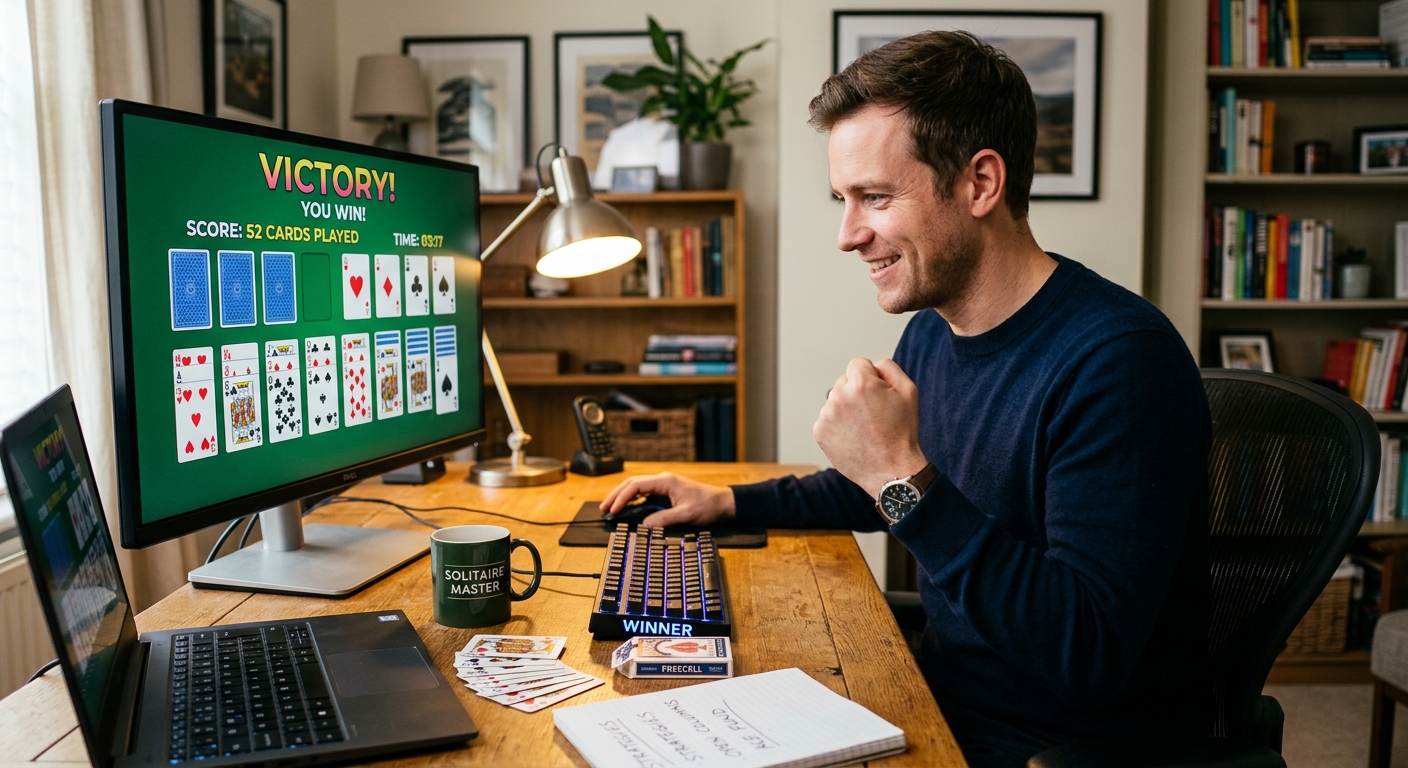
You deal a fresh hand, feel confident, and twenty moves later the board is a disaster. Free cells full. Columns jammed. No path forward. If that sequence feels painfully familiar, you are not playing unlucky cards. You are repeating a small set of fixable mistakes that most intermediate players make without ever naming them. The better news is that each mistake has a clear corrective habit, and learning them will lift your win rate faster than grinding through hundreds of random games.
- Why spending free cells too early is the fastest way to lose a winnable game
- How column blocking quietly destroys positions that looked perfectly fine
- The shift from reacting to single cards to planning in full sequences
- A repeatable pre-move scan that puts you in control before move one
- Concrete habits that replace each common mistake with a better default
The Gap Between Knowing the Rules and Consistently Winning
Most players who have spent real time with FreeCell understand the fundamentals. You know what the free cells are for. You know the foundations need to be built in suit from Ace to King. You can spot a legal move without hesitating.
But understanding the rules does not automatically translate into strong results. FreeCell punishes poor planning more harshly than almost any other solitaire variant. A careless move on turn three can quietly poison the whole game. The consequences do not show up until you are fifteen moves deep and the board is locked solid.
Extensive analysis of FreeCell solvability shows that over 99% of standard deals can be won with correct play. That number matters. It means the vast majority of your losses are not the game's fault. They are planning failures, and planning failures can be corrected.
Burning Free Cells Too Early and Why It Backfires
Free cells are emergency storage. They are not a first resort. Intermediate players tend to park cards in them the moment a move feels convenient. It seems harmless at the time. By move eight or ten, though, all four slots are full and the board has nowhere to breathe.
Once your free cells are gone, your legal move count drops sharply. You lose the ability to maneuver out of tight spots. A three-move sequence that needed one open free cell becomes impossible the moment that last slot fills up.
The corrective habit is deliberately treating each free cell like a resource with a real cost. Before parking a card, ask whether it genuinely needs to move right now, or whether you are making a convenient move instead of a purposeful one. If you can keep the free cell open, do it. Reserve them for moments when you need to break apart a sequence to clear a path.
A practical target: try to reach the mid-game with at least two free cells still open. If you consistently find all four filled before move twelve, you are spending them too fast and you need to slow down.
Column Blocking: The Mistake You Cannot See Until It Is Too Late
Column blocking happens when you bury a card you urgently need under a pile that cannot be cleared. The card is not gone. You can see it sitting there. Getting to it requires moving cards that have nowhere legal to go.
The frustrating part is that column blocking almost always develops through a series of individually reasonable moves. Each card you place feels logical in isolation. The cumulative effect is a critical card locked under an immovable stack three or four levels deep.
Watch for these warning signs before a block becomes permanent:
- A low-value card in a suit you need, such as a 2 or 3, sitting four or more cards deep
- The cards above a buried target are themselves blocked or already filling your free cells
- No empty columns remain to temporarily park a sequence while you dig
- One column keeps growing taller while every other column thins out
The fix is scanning below the surface before you build over a column. Before placing another card on top of a stack, check what is underneath. Ask whether anything buried there will need to come out within the next ten moves. If the answer is yes, think carefully before adding another layer.
Empty columns are your most powerful tool for unblocking tight situations. An empty column gives you temporary parking space to rearrange a problem stack. Filling it with a King just because it looks tidy is one of the most common ways players trap themselves later in the game.
Reacting to One Card at a Time Instead of Thinking in Sequences
FreeCell rewards players who think in groups rather than individuals. A sequence is a run of cards in alternating colors that can move together as a unit, provided you have enough free cells and empty columns available to support the move.
Players who have not internalized this tend to respond reactively. They spot a legal placement and take it. The board looks busy and active, but it is actually losing structure. Cards scatter in ways that prevent longer sequences from forming later on.
The shift in thinking is deliberate. Before moving anything, look at the tableau and ask: what sequences could I build here, and what do I need to free up to make them possible? A move that enables a four-card sequence three turns from now is almost always worth more than a convenient single-card placement made right now.
This connects directly to the supermove mechanic. The number of cards you can shift as a unit is determined by your available free cells and empty columns. Specifically, you can move (free cells + 1) cards for each empty column you have. Protecting those open slots is not just good practice. It is what makes large sequence moves physically possible in the first place.
Building a Repeatable Process Before Your First Move
One of the most impactful changes an intermediate player can make costs nothing but a few seconds. Most players click the first legal move they see and start reacting from there. Adding a short scan before the first move changes the entire dynamic of the game.
This kind of structured pre-move routine is central to the approach outlined in the FreeCell tips focused on repeatable strategy rather than improvisation. The core idea is simple: treat your first look at the board as information gathering, not move selection.
Here is a practical pre-move checklist worth running through before you touch a card:
- Identify which Aces are accessible or nearly accessible, and what it would take to get them to the foundation
- Note any 2s and 3s buried deep in columns, since those cards will become urgent soon
- Spot columns that are already tall and likely to cause blocking problems
- Count how many free cells you expect to need in the first ten moves and whether you have enough runway
- Look for sequence-building opportunities that do not cost you flexibility down the line
This scan takes fifteen to thirty seconds at most. It will not solve the game for you. What it does is replace reactive play with intentional play from the very first move.
Thinking Two Consequences Ahead, Not Just One Move
Beyond sequence planning, there is a layer of play that involves tracking consequences across moves rather than evaluating individual positions. Strong FreeCell players do not just ask whether a move is legal. They ask what that move makes possible and what it rules out.
Two moves ahead is a realistic starting point. Before committing, try to visualize the board after the move and at least one natural follow-up. Does the board look more open or more constrained? Is a critical card about to get buried? Are you spending a free cell for a result that could have been achieved without touching it?
This kind of thinking is a skill, not a talent. It gets faster with deliberate practice. Players who do it consistently stop making the moves that feel fine in the moment but quietly cost them the game three turns later.
How These Habits Come Together Into Real Wins
None of these adjustments works in isolation. Disciplined free cell management will not save a game where column blocking has already taken hold. A careful pre-move scan will not compensate for reactive single-card thinking in the mid-game. The reason these habits matter is that they build on each other.
When you stop burning free cells too early, you have more flexibility when the mid-game tightens. When you watch for column blocking from the start, you avoid the situations that require burning free cells to escape. When you think in sequences, your moves create open space rather than consuming it. When you run a pre-move scan, you catch problems before they have a chance to form.
Each habit reinforces the others. The cumulative effect is a shift from reactive to deliberate play, and that shift is where meaningful improvement in win rate actually lives.
FreeCell is not a game of luck. Given that nearly every deal is solvable, your win rate reflects your planning quality more than anything else. These corrections take attention and repetition to internalize. Once they become automatic, games that used to collapse at move twenty will start reaching a clean finish far more often.